
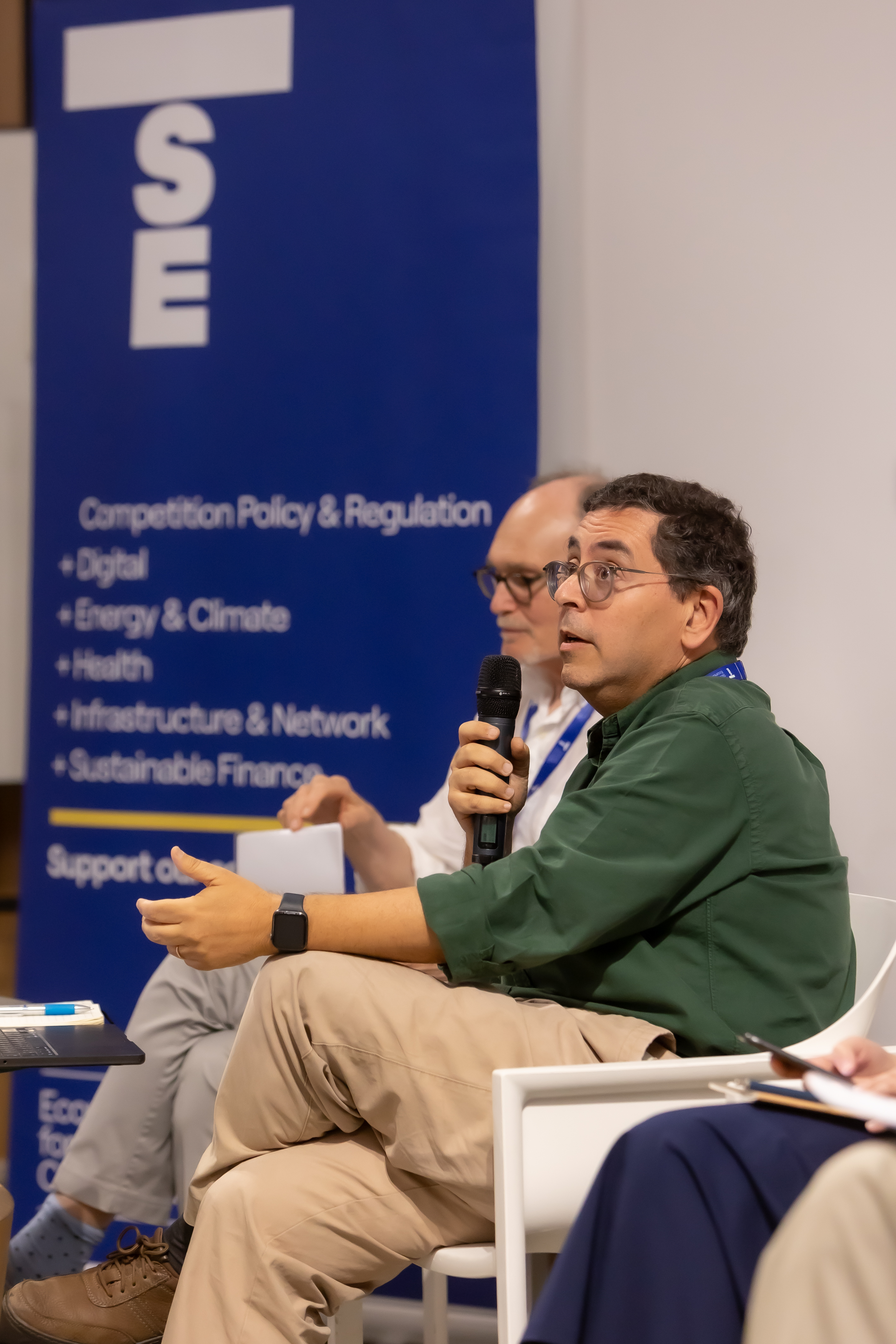
A month ago, I had the pleasure to participate in a roundtable at the 3rd Health Economics Conference at Toulouse School of Economics. It as a pleasure to discuss with Tina Taube (EFPIA), Jean Tirole (TSE, CEPR) and Adrian Towse (OHE UK). Here is a summary of my participation:
Setting up the stage:
Pharmaceutical innovation is a global activity, with three major blocks competing with each other: US, Europe and China. Each block has a different ecosystem of innovation. Each block wants to attract investment and lead in innovation.
A quick characterisation, as I see it:
US: leader in early innovation stages (science, capital, regulatory flexibility, patient engagement), excellent integration between academia, biotech, and finance.
Europe: strong scientific base and regulatory credibility; more attention to patient rights, and equitable access (this can gain relevance when dealing with gene editing technologies, use of AI in drug discovery, setting targets for personalized medicine. Fragmentation remains its main weakness.
China: powerful in industrial scale-up, manufacturing, and state-led coordination. Strong state investments in biotech platforms and strategic autonomy. Limited scientific culture of open debate.
There is an increasing role of industrial policy to promote innovation in pharmaceutical markets, as reflected in the European Union initiatives and revision of legislation. Industrial policy interacts with reimbursement / financial protection policies.
There are several tensions to solve
A European pharmaceutical innovation policy has to solve simultaneously several tensions:
a) Multiple objetives: promote innovation “that matters” (focus on unmet needs), provide quick access to innovation while financially protecting patients, and affordability of health systems (in many countries, public payers face budget pressures)
b) Double fragmentation in policies – different policies are in place and national policies differ across border; there is a need to have a fair distribution of gains
c) What models to use to reward innovation – a balance between decentralized innovation – patent system, and centralized – based on unmet need identification and targeted invesment (push and pull, instruments include: subsidies, investment on fundamental research, advance purchase agreements, joint procurement for innovation, prizes)
d) Philosophical approach – address market failures as in Blanchard-Tirole report versus sovereigty of europe as in Draghi report, the proposal for a Critical Medicines Act seems to be closer to the Draghi report spirit, though sharing some of the principles of the Blanchard-Tirole report.
How to find a path for European innovation?
Policies need to take seriously the importance of measures that contribute to the cohesion of the European Union. A focus on supply chains with parts of the chain located in different regions (countries) and a geographically decentralized R&D of advanced therapy medicinal products – medicines for human use based on genes, tissues or cells- can help to share the gains.
Also a European policy needs to be … European – overcome fragmentation of policies and reaching critical size in efforts (no single country of the EU, on its own, can match the efforts of US or China)
The focus should be in eliminating fragmentation, which is different than centralization – take advantage of size versus wanting to direct everything.
The concentration in US and China have a different context in each country, so EU needs to follow a different strategy to create the “cement” for larger innovation hubs.
What means defragmenting?
Common set of rules – joint clinical assessment is feasible; equal prices is harder (countries may legitimately have different valuations of innovation)
Common pool of venture capital to fund development – Capital Markets Union, to help on “from idea to market”. Outside the pharma and the health sector, but quite relevant.
Common policies – pool funds to promote high risk – high reward contests (example of Warp Speed program in the US for covid-19 vaccines, with different technologies competiting and with competition within each technology)
Common policies – set the rules for use of data for research purposes
Common policies – on business environment, set harmonised legislation concerning corporate law and insolvency
Common policies – joint advance purchase agreements – not only provides some certainty to companies, it may also help to distribute the gains across countries (again, covid-19 vaccines were a good example, there was no country complaining).
Common policies – quicker decisions at EU level – the need for a reshaped governance model, with also decluttering bureaucracy (as advocated in the Draghi report). Good European governance (and trust) is also required for resilience in face of future health threats – the question, in my view, is not to have joint stockpiles (we do not know what and when will be needed), the question is quick decisions regarding the ability to mobilise resources (including production and distribution) that will become essential in an unforeseen health crisis.
Questions for which I would like to have an answer:
How is AI used in pharma R&D and can Europe leapfrog both US and China in this new field? Or, at least, close the innovation gap in advanced technologies, as stated in the Draghi report. AI developmens may go from the R&D (the molecule) to the consumer (the patient bedside).
How can Europe have a dynamic landscape for business, meaning, challengers surpassing incumbents? (how to avoid the trap of selecting national champions). A particular note on competition policy and the health sector: agencies shy away from intervention in the health sector – it is complex, full of national policies, very different health systems, and many ways in which the model of “demand and supply” works differently.
How to progress, a large number of small steps or a small number of large steps? (many small initiatives so that each country seems something in it, or a large effort, with redistribution of gains later on).
How to deal with geo-strategic uncertainties? Partnerships in tiers can be an option: EU, Norway, UK, Switzerland; then, Japan, South Korea, Canada, Australia (industrial and R&D partners in different geographic markets). Unsure of where to place the relationship with the US.
Playing with European strengths: some action points
1. Make EHDS work – set the standards for health data, start when a minimum feasible number of countries joins effectively the EHDS – allow for staggered participation. In the process, solve the legacy data inclusion for all countries (this should be a technical issue, do not leave it for country-level funding, take it as an economic public good, that will be under-funded if left to each country Is decision). Europe has a large and diverse health data ecosystem (rich population-level health data registries in Scandinavia, France, Germany, UK, Netherlands, Estonia). GDPR, despite its complexity, offers a privacy framework that, if properly managed, creates patient trust for secondary data use. This initiative shows the advantage of collaboration and shares the gains. All countries, all firms, small and large can benefit from it.
2. From the Critical Medicines Act, the use more sophisticated award criteria in public tenders must be done in clever ways: avoid ambiguities that may trigger fears (or claims) of protection of some players, acknowledge that some trade-offs between criteria may not be linear (as it is often included in the rules of tenders). a question is how to bring in the new considerations supply security on top of low cost – instead of adding more criteria in tendering, should we go for more competition also as a result of procurement procedures? Play with asymmetric lots, ensure that more bidders than lots exist. Use economic theory to help design of new public procurement procedures.
3. A question that is not asked in reports which I find relevant in the health sector, and therefore relevant in pharma, is how local innovation ecosystems can contribute and participate in larger innovation ecosystems, My point is that generation of ideas and research opportunities can be identified at local level, and use local conditions as test beds, and then, when proving its worth, move the stage to the European level to grow. Going for hardcore manufacturing (perhaps too much for my taste): set an European Manufacturing Accelerator for Biopharmaceuticals (EMAB) – build large-scale EU investment in advanced manufacturing capabilities, that can provide scale to processes and ideas developed at smaller units around Europe, with a focus on biologics, Active Pharmaceutical Ingridients, cell & gene therapies – manufacturing that is highly skilled and capital intensive; set an affiliation mechanism to allow use of it; fund with EU public money, matching private funds (?) and have a system of repayment of use by successful cases. Use economics to set the governance principles and to get the public investment repaid.
4. One of the European strong points is education and training. Use it for patient expert integration into research, an underutilized resource. Patient experts are trained individuals with lived experience of disease. Patient experts can contribute with crucial insights at multiple stages of the pharma innovation cycle: priority setting, trials design, and early R&D screening. Create an European Patient Expert Academy (EPEA) for professional training and certification (discuss whether it is needed to formalize training, ethics standards, and quality control for patient involvement). Recognise that timings of patient participation are different according to conditions (chronic vs high mortality in short periods, Parkinson and variations vs pancreatic cancer) . Move away from just supporting patient organisations, bring professionalism to the activity while retaining the motivation that patients (and people close to them) have. Require patient involvement in EU-funded R&D projects and public-private partnerships. Build independent capacity of patient organizations with stable EU funding and avoid fragmentation by national borders. The US are already ahead on this, but in an unstructured way. There is the opportunity to leapfrog. Rationale: take the mission-oriented approach. Patients can bring “demand-side” signals, by active involvement in the definition of priorities, also gives more legitimacy to use of public funds for R&D, can avoid “me-too” innovation.
5. EU joint procurement for innovation addressing unmet needs that are consensual with “coalitions of the willing” (do not try to include everyone). May include advance purchase agreements. The procurement for innovation acts as launch customers by purchasing in goods or services that are new to the market, and address isues not taken up by decentralized innovation efforts. Learn from the Mellody project (platform in the context of European Innovative Medicines Initiative – creation of a global federated model for drug discovery without sharing the confidential data sets of the individual partners, It brought together 10 major pharmaceutical companies, academic institutions, and tech partners to collaboratively train predictive models on over 2.6 billion confidential data points without sharing proprietary datasets). Learn from value-based procurement initiatives (example: the Catalonia’s medtech experiences). There are already intentions for joint procurement (with variable number of countries). Just take one step further, to include procurement of innovation.
Main principles to adopt:
Industrial policy initiatives should be designed to correct market failures
There should be efficient design of public-private incentives
We should see patient expert integration in research as efficiency-enhancing, as a contribution for more relevant outcomes to be used, as a way to define governance for coherence and legitimacy (this should have international coordination, at EU level at least).
From the roundtable discussion
It was consensual that the European market needs to remain competitive in the globe, with future investments also coming to Europe. For this, the European pharmaceutical strategy needs to have a new impetus, which implies the need to have a new governance model or then using with flexibility what exists. The key point is to modernize and accelerate decisions.
On the access issue (earliest possible access of patients to new therapeutic options), the definition of access prices needs to avoid the “one-size-fits-all” approach.
Globally, Europe should act as an effective purchaser, which is hard as there is no such thing as a EU health system, and it is not going to exist, as different preferences, different traditions, and diverse ability to pay across countries will render very difficult (impossible?) to create a EU health system.
The access to market should not be seen as the formal ability to pay but rather as patients using the available products, which will likely need price differentiation across countries. Forcing price convergence of list prices will likely have less innovation and less access. Thus, confidential discounts are needed (ora similar process to generate price differentiation), which clashes with calls for “price transparency”.
The European Health Data Space (EHDS) is crucial to keep European attractiveness for investment and introduction of products, and should be at the center of European strategies. Thus, industrial policy aimed at pharmaceutical innovation in Europe has several lines of development to pursue.


 Momentos económicos... e não só